

There are moments in business history when the window of opportunity is wide open. AI is one such moment. Problems that were considered too costly to solve five years ago can now be resolved in a matter of weeks. Processes that used to take dozens of hours can now be automated with just a few clicks. Revenue streams that were once out of reach are now within reach.
The question is no longer whether you should integrate AI into your organization. It’s how to get the most out of it to gain a lead that’s hard to catch up with.
In this article, we explore how to move from isolated experimentation to a concrete organizational AI strategy. You’ll find use cases by department, quantified results achieved by the Nexapp team, and an action plan to start making a real impact.
Whether you’ve been tasked with integrating AI into your organization or are feeling the pressure to take action without knowing where to start, this article is for you.
Before deploying AI: What you need to understand
Moving from individual AI to organizational AI
The arrival of ChatGPT has sparked an unprecedented wave of adoption. In just a few months, thousands of employees have started using tools like Copilot, Midjourney, and Notion AI to write, summarize, research, and brainstorm. The “wow” factor was undeniable.
But these one-off individual gains don’t automatically translate into a return on investment for the organization. An employee who saves 30 minutes a day on writing emails is great. A company that automates an end-to-end billing process, reduces its estimation time by 90%, or unlocks millions in untapped revenue potential—that’s a whole different story.
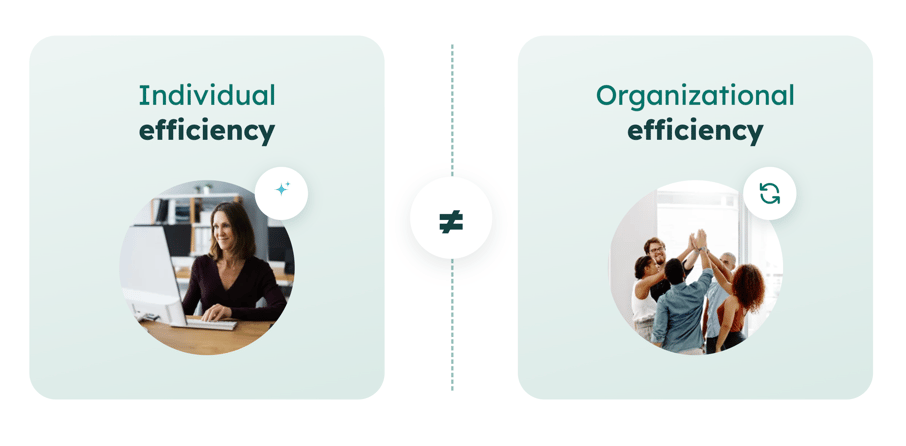
Organizations that achieve truly significant results with AI do something different: they integrate AI into their business processes rather than simply handing it off to their employees.
Recognizing the signs of underutilized AI
They’re easy to spot: a proliferation of uncoordinated tools, scattered or unreliable data, employees experimenting with AI without a framework, and management unable to measure the benefits. Added to these are very real risks related to privacy, compliance, and the quality of the generated responses.
The result? Mounting expenses and untapped potential.
Avoid automating without rethinking the process
AI shouldn’t simply speed up a flawed process. It should transform it. Before automating anything, you must first identify where the real opportunities lie: bottlenecks, repetitive tasks with low added value, decisions lacking data, and areas where the customer or employee experience can be improved. That’s where a true strategy for integrating AI into a business begins.
Go to the source rather than jumping to solutions
There’s an even more subtle pitfall: most organizations come in with a solution already in mind. “We want a chatbot.” “We want to automate our reports.” This is a natural reflex, but it skips over the most important step. Before implementing a solution, you have to go back to the root cause: why a chatbot? What problem are we really trying to solve? If everything were working perfectly, what would be different? It’s this process of reverse engineering that ensures we’re tackling the right problem—and not just the one that seemed obvious at first.
How can you successfully integrate AI into your business processes?
Using AI means adopting a tool. Integrating it means transforming the way your organization does things. The distinction may seem subtle, but it makes all the difference when it comes time to measure results.
Let’s take a simple example. If your goal is to increase revenue by 20% this year, the fact that an employee writes emails in 10 minutes instead of 30 probably won’t bring you any closer to that target. That time savings is real, but it’s disconnected from what really matters to the organization.
This is where many companies go astray. By starting with the available tools rather than the goals to be achieved, they end up optimizing tasks without ever addressing the real problems. Successful AI integration is the opposite: you start with the business objective, identify the obstacles preventing you from achieving that objective, and then develop the most appropriate AI solution to eliminate them.
Understanding the difference between “using AI” and “integrating AI”
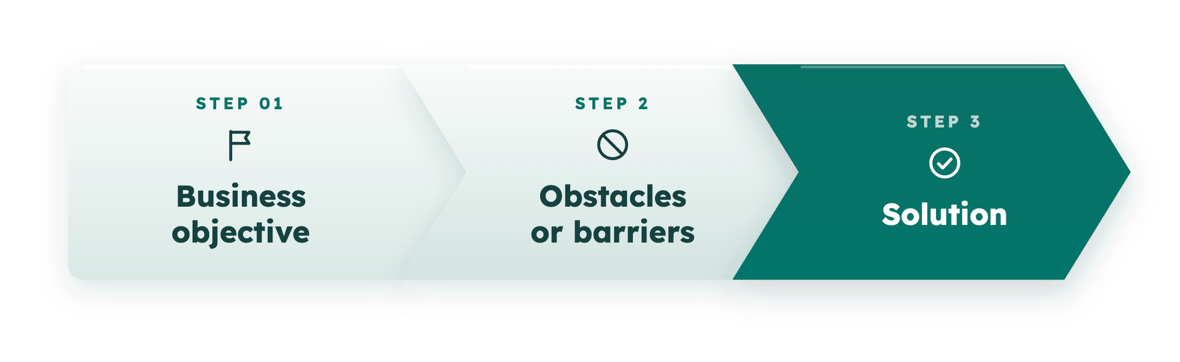
To truly transform an organization, AI must become an integral part of business processes. In practical terms, this means connecting to existing systems (CRM, ERP, intranet, HR tools, financial platforms), automating workflows, centralizing data, and creating specialized assistants tailored to specific roles or departments.
This approach results in concrete and measurable organizational benefits, such as reduced time and effort spent on critical processes, increased revenue, improved decision-making, and lower costs.
Viewing AI as an accessible driver of digital transformation
A few years ago, certain challenges faced by organizations were clearly identified and quantified, but were deemed too costly to solve through technology. The potential benefits were there, but the effort required was too great to justify the investment. AI has changed that equation.
Take, for example, companies that must respond to requests for proposals. This task can take several weeks of work: reading hundreds of pages of documents, extracting requirements, verifying compliance, drafting response sections, and coordinating with multiple in-house experts. As a result, many organizations choose which RFP responses to submit not because the opportunity is unpromising, but because they lack the capacity to handle everything. Today, AI can analyze a request for proposal in just a few minutes, identify key requirements, flag areas of risk, and generate a preliminary draft response based on past submissions. What has changed is not the problem itself. It’s the cost and effort required to solve it.
Recognize that the impact comes from adoption, not just from the technology
Picture the scene. Your boss walks into your office, looking serious: “We absolutely have to bring AI into the company. We’re going to add a chatbot to the website to take some of the load off the customer service team. You’re in charge.” You get to work. Six months of effort, budget, and integration. And in the end… no one uses it. And the few customers who do try it are even more frustrated than before.
What happened?
If you’d taken the time to identify the real problem by talking to customer service employees and analyzing the data, you would have discovered something interesting. Simple questions? Customers already handle those themselves using the FAQ. The ones who call customer service do so precisely because they have a complex problem. They want to speak to a human. The chatbot frustrates them and then refers them to an agent anyway.
The result: you haven’t solved the problem. You’ve added friction. The real issue wasn’t the volume of calls, but the complexity of the requests. And that leads to a completely different solution.
That’s why getting out into the field before choosing a solution isn’t optional. Understanding the real problems teams face—the ones that actually prevent them from achieving the organization’s goals—is what separates an AI project that creates value from one that creates friction.
AI in action: From education to manufacturing
Here are three concrete examples of AI projects integrated into end-to-end processes, drawn from our team's work: AI in education, AI in manufacturing, and AI in the insurance industry.
Reducing teachers’ grading time by 75%

Collège Sainte-Anne comprises six schools, ranging from preschool through college. Following a survey of the teaching staff, the problem to be addressed was clear: grading French writing assignments took up a disproportionate amount of teachers’ time, to the point of limiting the number of exercises students could complete.
Since the tools available on the market were not suited to their needs, the team co-created a solution with the teaching staff. The result: Emilia, an AI-powered app that adapts to each group’s grading rubric, generates personalized feedback for students, and provides an overview of the class’s skills. Within three months, a first working prototype was delivered. Today, Emilia has already processed more than 25,000 written assignments, enabling teachers to grade three times faster.
$3 million in additional revenue generated in the manufacturing sector
Vibrotech manufactures custom material-handling equipment in Plessisville. With over 30 product types, each project is unique, and each quote could require up to 25 hours of work by a specialist. Sifting through catalogues hundreds of pages long, copying and pasting between multiple sources, and validating technical specifications: the process was time-consuming, fragmented, and relied on the undocumented expertise of a few senior estimators. As a result, the company’s ability to submit bids directly limited its growth.
To unlock gains quickly, Nexapp focused on a single piece of equipment to start with: the most complex one. Within a month, estimators were already testing an initial prototype. The solution developed centralizes business rules, formulas, and project history on a secure platform. The estimator enters the project information; the platform performs the calculations and automatically generates a PDF quote ready for the client. A chatbot also allows users to query project history using natural language, just as they would when talking to colleagues.
Estimation time has dropped from 6 hours to 30 minutes for the targeted equipment—a 12-fold increase in speed. Ultimately, estimation capacity will increase by 50%, and the potential for additional revenue will reach $3 million, with a projected return on investment in 1.21 years.
A return on investment achieved in six months in the insurance sector
In the insurance industry, processing a single policy could take up to 45 minutes of manual work, multiplied by more than 43,000 PDFs processed each year. Azimut Lab, an InsurTech company specializing in tools for insurance brokers, wanted to address this operational burden, which was directly limiting their ability to grow.
Nexapp’s approach began with a strategic workshop to quickly identify and validate the best area for improvement. Billing emerged as a clear priority. In less than two months, a fully automated, fully integrated system with existing operations was up and running. Today, 80% of policies are processed automatically from start to finish. Projected savings over five years amount to $700,000 for a single brokerage firm, and the return on investment was achieved in six months.
AI use cases in businesses by department
AI can create value in virtually every department of an organization. But before we explore the use cases, it’s worth revisiting an idea introduced earlier: an individual benefit does not automatically translate into an organizational benefit.
Imagine a four-step invoicing process (purchase order, registration, approval, invoicing) where each step is handled by a different person.
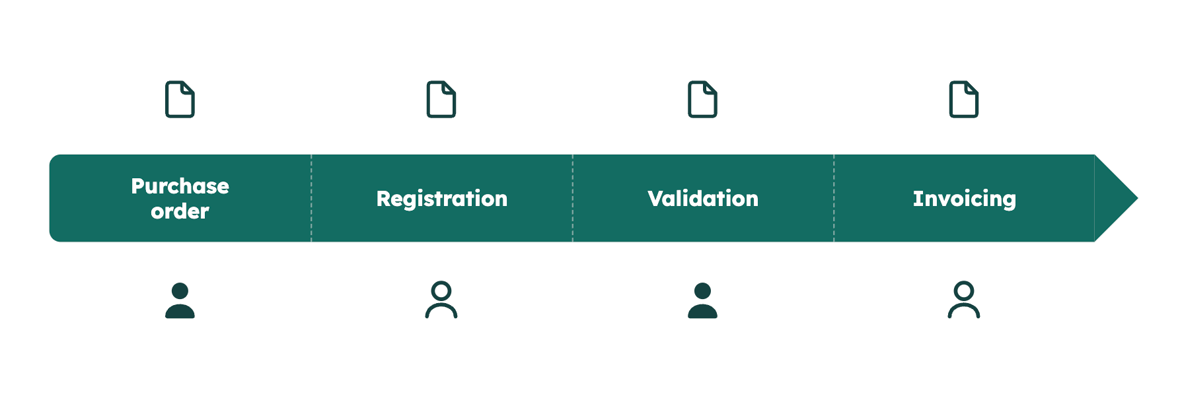
If the person handling the first step starts using AI to extract information more quickly, they may see increased productivity.
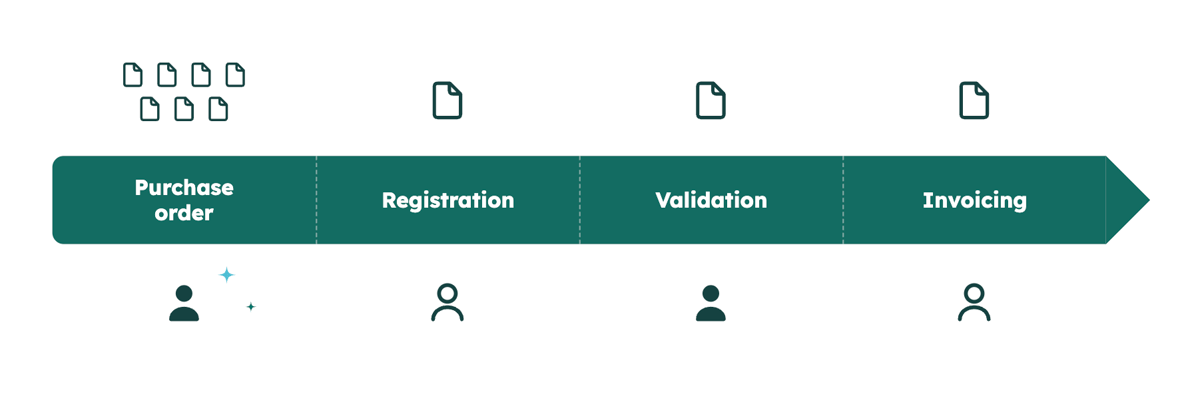
But if the other team members don’t have the tools to help them work faster, the overall process continues to get bogged down at the second step. The person in charge of purchase orders may have tripled their productivity. However, invoices continue to be issued at the same pace as the entire process.
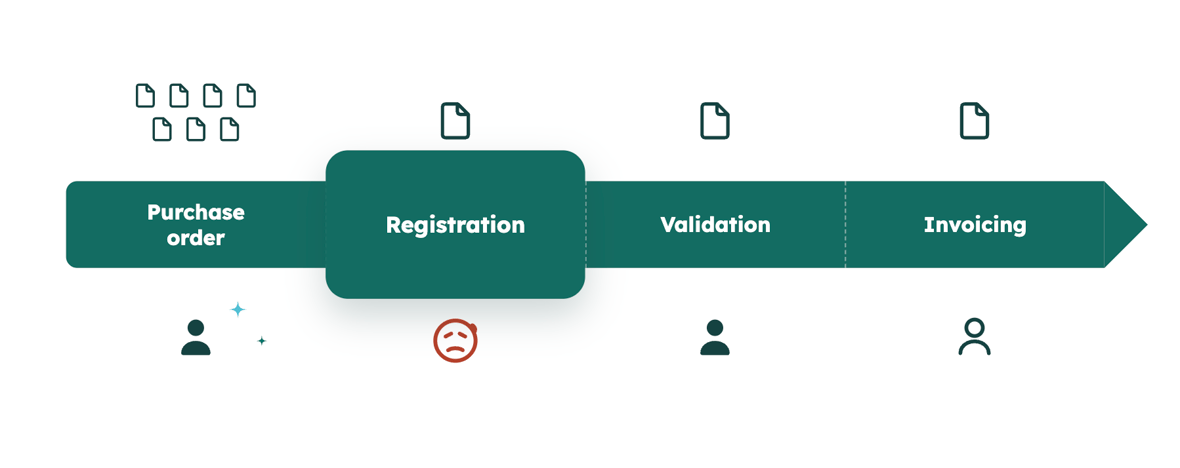
It’s actually very rare in a business setting to work completely in isolation from other team members. That’s why the AI use cases in business presented below should not be viewed as a list of tools to distribute to your teams. They represent opportunities to transform entire processes—provided they are deployed at scale and integrated with existing systems.
AI and Human Resources
From recruitment to retention, HR teams handle many repetitive, low-value-added tasks. AI can automate application screening, personalize onboarding experiences, answer employees’ frequently asked questions, and analyze workplace culture using available data, thereby freeing HR professionals to focus on issues that truly require their judgment.
AI and Marketing
AI enables marketing teams to produce more content, personalize it at scale, and better target their efforts. Predictive lead scoring and audience segmentation based on actual behavior allow teams to focus their resources where the chances of conversion are highest.
AI and Sales
Sales teams spend a significant portion of their time on administrative tasks: follow-up notes, call summaries, and CRM updates. AI can handle these tasks automatically, while also helping to qualify leads, analyze recurring objections, and generate more reliable revenue forecasts.
AI and Operations
In operations, AI excels at detecting patterns that humans cannot monitor continuously: inventory levels, quality anomalies, and early warning signs of equipment failure. Predictive maintenance and schedule optimization are among the use cases with the highest return on investment in this department.
AI and Finance
Accounting teams can use AI to automate reporting, categorize expenses, detect anomalies, and refine budget forecasts. Tasks that used to take days can now be completed in just a few hours with greater reliability.
AI and Customer Service
This is often the first department where organizations deploy AI, and one of the most prone to failure. When properly integrated, AI agents can handle request triage and answer simple questions, allowing human agents to focus on complex situations that require empathy and judgment.
Beyond departments: High-potential use cases
Some enterprise AI applications do not belong to any specific department; they create value across the entire organization. Their organizational potential is real, but it hinges on the same condition as for department-specific use cases: the solution must be deployed at scale, integrated with existing systems, and adopted by teams. This is the difference between a tool that a few people use from time to time and a process that has undergone a profound transformation.
- The internal knowledge assistant is one of the most telling examples. Rather than searching through dozens of documents, bothering a colleague, or waiting for a response from management, team members ask their questions in natural language and receive an answer drawn directly from internal documentation (policies, procedures, guides, FAQs). When deployed organization-wide, the time savings are immediate, and reliance on internal experts decreases significantly.
- Document automation follows the same logic. Contract summaries, information extraction, document classification, report generation, and form validation: these are tasks found in nearly every department that consume considerable time without creating real value. AI can reliably handle these manual and repetitive tasks.
- Finally, decision support is perhaps the most strategic use case. Augmented dashboards, predictive scenarios, and operational recommendations based on the organization’s actual data: AI does not replace human judgment; it provides a better foundation for making decisions. And when these tools are directly linked to business objectives, they cease to be mere dashboards: they become decision-making levers.
AI tools in businesses: Off-the-shelf solutions or custom development?
With the growing range of AI tools available (co-pilots, no-code tools, open-source models ), the question quickly arises: is it better to buy an off-the-shelf solution or have something custom-developed? The straightforward but honest answer: it depends on where you are in the process.
Off-the-shelf solutions can help you get started. They’re quick to deploy, affordable, and sufficient for standard needs. To test a use case, validate a hypothesis, or address a simple need, they’re often the most sensible starting point.
But they quickly reach their limits when the challenges become more complex. Knowledge specific to your organization, confidential data that cannot pass through external servers, the risk of errors in contexts where precision is critical, and the need for advanced customization: this is where custom development becomes not a luxury, but a necessity.
However, custom development doesn’t mean starting from scratch. The best solutions combine both approaches: an architecture developed specifically for your organization, its processes, and its business rules, into which AI models from major players (OpenAI, Anthropic, Google) are integrated, where they add the most value. This allows you to leverage the power of state-of-the-art models while retaining control over your data and business logic.
Let’s look at a concrete example.
The architecture below is that of the Emilia project, presented earlier. It includes a web application, an authorization system, centralized storage organized by data type, a processing queue, a correction service that orchestrates the AI models, and a full support infrastructure: continuous deployment, monitoring, and a model registry. The large language model, meanwhile, occupies just a single block in the upper-right corner.
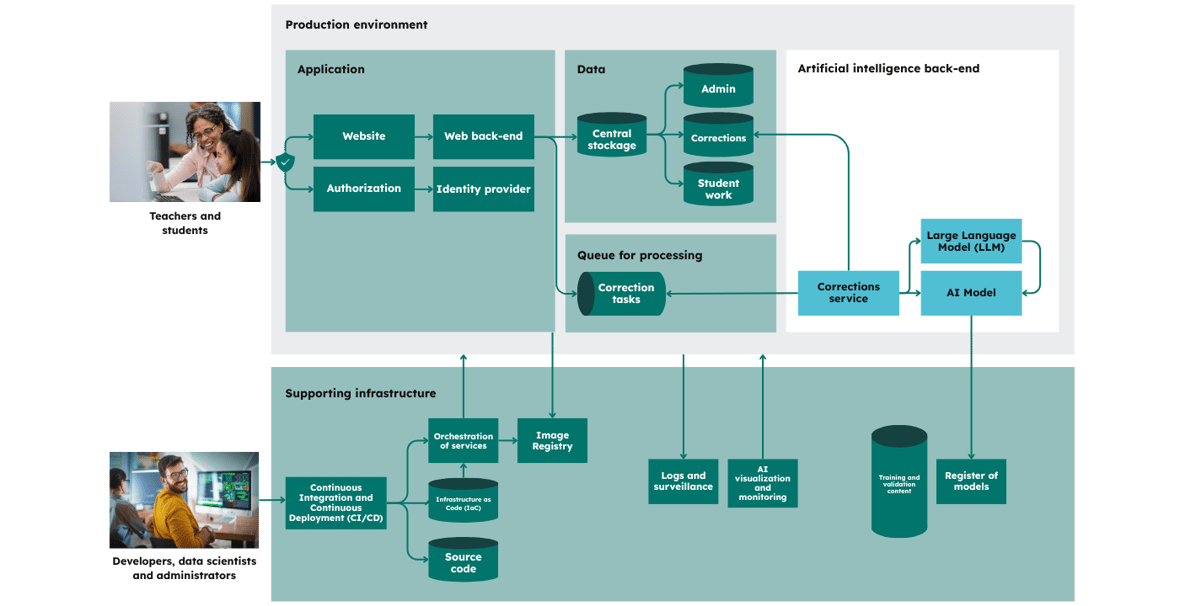
This is what most organizations fail to see when they think about an AI project: artificial intelligence is just one component of a complete software system. It’s the architecture surrounding it—the way data flows, how business rules are encoded, and how the solution integrates with existing systems—that determines whether it delivers real value or not. And that is precisely what a generic solution cannot do for you.
How can you measure the return on investment before embarking on an AI project?
One of the most common mistakes we see in AI projects is spending weeks estimating the cost of a solution before even knowing whether the problem is worth solving.
At Nexapp, we recommend the opposite approach: start by quantifying the impact of the status quo. How much is this problem costing you today—in terms of time, lost revenue, and operational risks? How much would solving it save you? It’s this budget that determines what it’s reasonable to invest in a solution. And within this budget, we assess whether the project is worth moving forward with.
This way of framing the issue also changes the conversation around the budget. When the return on investment is clearly established, the cost of the project becomes secondary. A $200,000 project that generates $1 million in value isn’t an expense—it’s a lever. That’s why at Nexapp, we dedicate a strategic workshop specifically to this work with our clients: identifying the right problems, quantifying their impact, and validating that the proposed solution is worth the investment before writing a single line of code.
Once the project is launched, defining the right success metrics from the outset (even before choosing a solution!) enables credible value demonstration and long-term management buy-in. These metrics must be directly linked to the business objectives identified at the outset. Here are the most common ones, by type of benefit sought:
|
Objective |
Metric |
|
Reduce processing time |
Minutes or hours saved |
|
Improve productivity |
Number of tasks completed per employee |
|
Reduce costs |
Cost per transaction or per request |
|
Improve customer service |
Response time, customer satisfaction |
|
Accelerate sales |
Conversion rate, sales cycle length |
|
Reduce errors |
Error rate (before/after) |
But time and money don’t tell the whole story. Some gains are harder to quantify yet just as real: the quality of decisions made, employee satisfaction, improved customer experience, reduced operational risks, and standardized processes. To ignore them is to underestimate the true value of an AI project. And sometimes, that’s precisely where the most lasting impact lies.
The 4 pillars of an organizational AI strategy
An AI strategy is about more than just a tool. What sets apart a project that creates lasting value from one that fizzles out after a few months is the ability to advance four dimensions simultaneously.
1. Alignment with the organization’s objectives
It all starts here. AI must serve the organization’s priorities, not the other way around. This means starting with business objectives to identify the right use cases, rather than deploying tools and hoping they will create value on their own.
2. AI Governance
Rapid adoption without a framework poses a real risk. Confidential data ends up in unapproved tools, knowledge remains scattered across employees’ personal applications rather than benefiting the organization, and compliance issues quietly pile up. Effective AI governance encompasses data protection, security, compliance, rules for using AI tools, and human validation of critical decisions.
3. Change Management
Even the best technology in the world won’t generate a return on investment if teams don’t adopt it. Training managers and users, creating internal AI champions, documenting best practices, and supporting the change process—these are the elements that turn a deployment into true adoption. Without them, the money invested is wasted.
4. Data Architecture and Technology Choices
Technology decisions (build vs. buy, integration with existing systems, quality of available data) directly determine what AI can deliver. A solution that is well-designed from the outset evolves with the organization. A poorly architected solution creates technical debt and constraints that hinder growth.
Strategic action plan: Integrating AI into your business in 90 Days
When embarking on a major digital transformation, it’s tempting to want to plan everything out before getting started. Weeks spent in conference rooms, a three-year Gantt chart, and a comprehensive budget. On paper, this instills a sense of confidence. In practice, it delays the moment when you truly learn what works. And all the while, technology is evolving every day.
The approach we recommend at Nexapp is different.
1. Target: Identify high-potential processes
Before considering a solution, take stock of the problems your teams face. Which processes are holding back growth? Where are the bottlenecks? Which repetitive tasks are time-consuming without adding value? This work is done on the ground by talking with the teams who deal with these issues daily.
2. Prioritize: Use the impact/effort matrix

Not every issue deserves to be treated as a priority. For each opportunity you identify, ask yourself the following question: What is the financial impact of maintaining the status quo? This question is what distinguishes true drivers of change from minor annoyances.
A concrete example: customer complaints about slow customer service responses may seem trivial at first. But if these complaints put the renewals of 10% of your customers at risk, the potential impact suddenly becomes $500,000 in revenue. It’s no longer a minor annoyance—it’s a priority. Conversely, if you’re considering addressing this issue because you received 3 complaints last week—when you’ve only received 2 all year—it’s a rather circumstantial annoyance. It’s this strategic calculation that should determine where a problem is placed on the matrix.
Only once the impact of the status quo has been quantified can we begin to discuss solutions. And that’s where the impact/effort matrix comes in: prioritize cases where the potential impact clearly outweighs the required effort. That’s where the return on investment is most achievable.
3. Test: Start with a proof of value
Once you’ve identified the top priority problem, rather than overhauling an entire process all at once, focus on the most strategic use case and quickly deliver an initial working solution. The goal isn’t perfection—it’s to get something into users’ hands within a few weeks to confirm that it’s worth pursuing further. At Vibrotech, we focused on a single piece of equipment—the most complex one. If the solution worked for that piece of equipment, it would work for all the others—and we’d know that faster than if we’d tried to tackle all the equipment at once. The result: within a month, estimators were already testing the solution and seeing time savings.
4. Validate: Involve the field team
Proof of value isn’t validated in a conference room either. It’s validated in the field, with the people who will use the solution on a daily basis. Their feedback helps confirm that the real problem has been addressed and prevents the large-scale deployment of a solution that misses the mark.
5. Adjust: Continuously Improve
Adjustment takes place on two levels. First, the solution itself: once it’s available in the field, it evolves based on what the teams learn as they use it. Second, the roadmap: what you’ve learned during the initial operational trials redefines priorities for the future. What seemed complex sometimes becomes simple. What seemed urgent sometimes becomes secondary. It is this ability to continually adapt that distinguishes enterprise AI projects that create lasting value from those that run out of steam after the initial deployment.
In conclusion
AI creates significant value when it addresses the right problems, is embedded in processes, and is aligned with the organization’s goals. The companies that derive a real return on investment aren’t necessarily the ones that have invested the most: the technology is more accessible than ever. What’s rare is the ability to identify the real problem that’s worth solving and turn it into a measurable competitive advantage.
Would you like to identify the best use cases for AI in your organization? Nexapp can help you define, design, and implement an AI strategy tailored to your business processes. Contact us.
FAQ
What is AI in business?
Artificial intelligence in business refers to the use of AI technologies to automate repetitive tasks, analyze data, predict trends, and improve business processes. Unlike the individual use of tools such as ChatGPT, AI in business is integrated into existing systems and workflows to create measurable value across the entire organization.
What are the best use cases for AI in business?
The most promising use cases vary by organization, but opportunities exist in virtually every department: recruitment and onboarding in HR, lead personalization and scoring in marketing, lead qualification and customer follow-up in sales, predictive maintenance in operations, anomaly detection in finance, and automated triage in customer service. Cross-functional use cases (internal knowledge assistants, document automation, and decision support) also offer strong potential for return on investment.
How can you measure the return on investment of AI?
The return on investment for an AI project is measured by increased revenue, time saved, cost reductions, improved decision-making, customer satisfaction, and operational performance. The key is to define the right metrics before deployment (not after!) and to link them directly to the business objectives identified at the outset.
Is ChatGPT enough to integrate AI into a business?
ChatGPT can be a good starting point for exploring the possibilities of AI. But the real impact comes from integration with the organization’s internal processes, data, and tools. A generic solution used in isolation yields only short-term gains. A solution that connects to existing systems and is deployed at scale drives organizational transformation.
Where should you start with an organizational AI strategy?
Start by conducting a process assessment to identify bottlenecks and high-potential repetitive tasks. Next, prioritize AI use cases within the company where the financial impact of maintaining the status quo is highest and where the required effort is reasonable. Then conduct rapid testing with a targeted proof of value before rolling out the solution at scale.
Continue reading