

Artificial intelligence can transform an organization. It can automate entire processes, free your teams from repetitive tasks, speed up decisions that once took weeks, and generate savings in the millions. This potential is no fantasy: local companies are already making it a reality, backed by hard data.
So why do so many executives feel like they’re going in circles with AI?
Part of the answer lies in the noise surrounding the topic. When it comes to AI, you read everything and its opposite: AI is going to revolutionize everything; AI is a disappointment; some projects fail, while others generate spectacular returns. For every statistic, there’s one that says the opposite. And by constantly searching for the truth in the headlines, we end up forgetting the essential point: the right answer isn’t found in the media—it’s found within your organization.
The companies that derive real value from AI are those that have asked the right questions about their own processes, identified the right problem, and structured their approach to move from idea to results.
At Nexapp, we’ve been supporting organizations through this process for years. We’ve seen what sets projects that deliver results apart. Today, we’re sharing three pitfalls that most companies encounter—and, more importantly, how to avoid them.
Pitfall 1: The Technological Illusion
Since the arrival of ChatGPT, AI has proven that it can do almost anything. An email drafted in ten seconds, a 300-page report summarized with a single click, an interface generated from a simple query. Faced with such power, we’ve quickly developed a kind of magical thinking: if AI can do all that, surely all we need to do is give everyone licenses to transform the company.
This is partly true. But only partly.
To fully understand this, we need to distinguish between two types of AI. On one hand, individual AI:
- Generic
- Accessible
- Easy to implement
- Inexpensive
This generally refers to a license for a tool that helps an employee save time on their tasks.
On the other hand, organizational AI:
- Integrates deeply into your processes
- Leverages your data
- Automates operations from start to finish.
The first delivers individual efficiency gains. The second delivers organizational efficiency gains—and that’s what sets you apart from your competitors.
The technological illusion is believing that the sum of individual gains will automatically translate into business transformation. I can hear you saying, “Come on, if each of my employees becomes 5% more efficient, the company is bound to gain 5% in productivity.”
That sounds logical. Here’s why, in reality, it isn’t.
Take the invoicing process, for example. At each stage, someone processes documents: purchase orders, registration, approval, and invoicing. If the person who reviews purchase orders starts using an AI tool to extract information from PDFs, they save time. But the process itself continues to get bogged down at the next stage, which remains manual. The time savings are real, but they’re isolated. They get swallowed up by the bottleneck further down the line. Worse yet, an already shaky process can deteriorate even further when you speed it up in just one place.
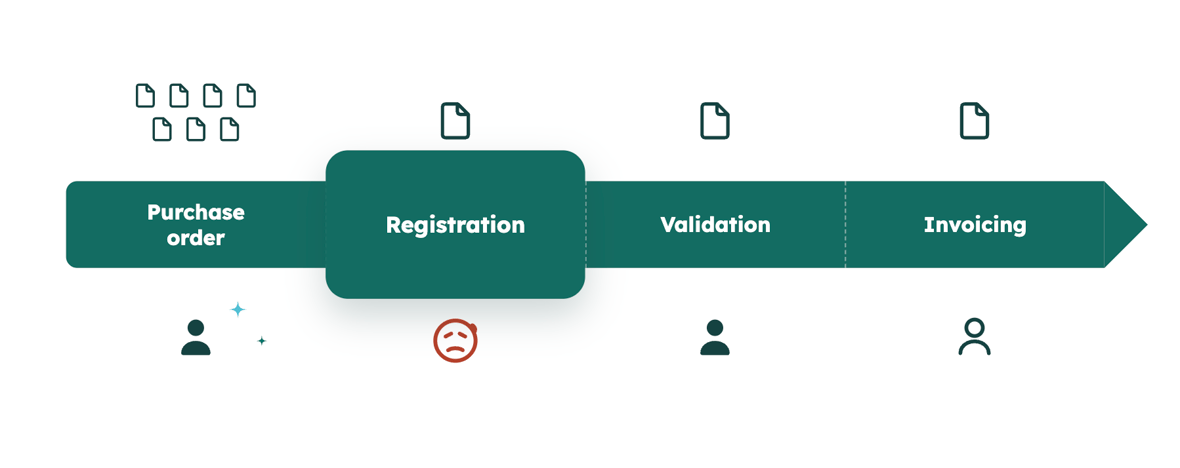
True value doesn’t emerge when AI helps a person. It emerges when AI transforms a process. Empowering your teams is a good starting point, but don’t confuse this first step with the destination.
Pitfall 2: Poor Initial Targeting
Many AI projects fail before they even begin. Not because of the technology—this is a problem that existed in technology projects long before AI became widespread—but because people got carried away with a solution before they had clearly defined the problem.
Einstein summed it up better than anyone: “If I had an hour to solve a problem, I’d spend 55 minutes thinking about the problem and 5 minutes thinking about solutions.” We’ve all been tempted by technology to the point of wanting to dive in headfirst. But before choosing the tool, we still need to tackle the right problem.

At Nexapp, we use a funnel-based process to achieve this.
- We start with the client’s business objective.
- We then identify the problems that are slowing them down or preventing them from achieving that objective.
- We quantify the impact of solving each of these problems to pinpoint the one whose resolution yields the greatest return.
- And only then do we consider the solution, whose cost must remain reasonable relative to the expected return.
Objective, problems, benefits, solution: in that order.
Let’s look at a concrete example. Azimut Lab is a Quebec-based InsurTech company that develops tools for insurance brokers. Its objective: to improve its clients’ operational efficiency. Among the problems hindering this objective, one stood out: billing.
The numbers spoke for themselves. For a single client, thirty people were assigned to this task, spending twenty-five minutes a day copying and pasting information from one system to another. A repetitive task with no added value—and demotivating for skilled employees capable of so much more. Difficult to staff, difficult to retain, and rife with the risks of costly errors inherent in any manual data entry. In short, a direct obstacle to the organization’s growth.
Upon assessing the potential return on investment of addressing this problem, the conclusion became clear: it had to be resolved as a top priority. We’ll come back to this with the full figures, but suffice it to say that the question was no longer whether to act, but how quickly.
Pitfall 3: The Transition from Pilot to Deployment
This is where projects most often fail. Even when the targeting is sound, the vast majority of AI initiatives get stuck at the pilot stage and never reach full-scale deployment. According to the MIT study on the state of AI in business, barely 5% of custom AI tools make it into production.
The result is a graveyard of pilot projects—promising initiatives, launched with enthusiasm, that have cost time and money without ever delivering real value. If you talk to executives around you, you’ll often hear the same story: a project that’s been underway for months, sometimes years, with concrete results still pending.
How can you avoid this fate? It starts with redefining what a pilot project is.
Not so long ago, running a pilot meant conducting a proof of concept: verifying that an idea was technically feasible. But in 2026, with the technologies available, we already know that most of the AI use cases we envision are feasible. The real question is no longer “Can this work?” but “Is it worth it in our context?” We’re no longer looking to prove a concept; we’re looking to prove value.
A good pilot—one that breaks through the deployment barrier—meets four criteria:
- It measures observable business value. Not a vague impression that AI is working well, but a concrete, meaningful metric for an executive, such as “90% of invoices processed automatically.”
- It can learn and evolve. The solution incorporates a feedback loop: it detects its limitations, documents cases it cannot yet handle, and continuously improves.
- It integrates into the actual workflow. Real systems, real data, and real users are involved from the very first tests, with a clearly identified business owner.
- It builds organizational trust. A tangible “before and after” that gives the entire organization the confidence needed to scale up.
At Azimut Lab, that’s exactly the approach we took. We built a proof of functional value in two months, directly integrated with their tools, data, and teams. The solution is based on an AI-driven document ingestion process: all documents are analyzed; only those that meet the validation rules proceed through the full workflow, while the others are rejected with an error code that allows for immediate correction. This mechanism handles exceptions and human errors, which allowed us to quickly put the solution into production, delivering the dual benefits of automation and standardization.
After two months, the pipeline was processing two hundred documents with a 100% success rate. The enthusiasm among the teams was palpable, and the green light for deployment was clear.
The Results at Azimut Lab
The strength of this approach is that it’s measurable. Here’s how the project progressed, step by step.
- It all started with targeting.
A $20,000 investment and workshops spread out over four to six weeks were used to determine where AI would have the greatest impact. It was this work that identified billing as a priority. - Next came the proof of value.
About $120,000 over two months to deliver a functional solution integrated into actual operations. The challenge wasn’t to prove that documents could be analyzed using AI—we already knew that. It was to demonstrate the value within the specific context of Azimut Lab, taking into account their systems, technology stack, and security requirements. That’s exactly what was accomplished. - Building on this result, Azimut Lab gave the green light to the full-scale project.
A large-scale deployment is currently underway.
And the impact? A return on investment achieved in eleven months, and estimated cost savings of $6.1 million over five years.
But perhaps the most telling figure lies elsewhere—in the trust the project has generated at every level of the organization.
- Trust from the front lines, because employees saw that the solution was truly helping them.
- Trust from senior management, because the project was creating measurable value.
- Trust from the IT and legal teams, because the solution was robust and compliant with rigorous security policies.
- And trust from the accounting department, because the absolute reliability of financial transactions was non-negotiable.
That’s what it means to turn AI into a business driver: real value that the entire organization can trust.
Where to Start in Your Organization
If these three pitfalls have one thing in common, it’s that they can all be avoided with the same approach: start with your reality rather than the technology. Here’s how to get started.
- Start with the problem, not the tool.
Before asking yourself which AI to adopt, ask yourself what specific problem is holding your organization back the most—or which one, if solved, would generate the most value. That’s your starting point, and it will determine everything else. - Focus on organizational value, not just individual efficiency.
Licenses that save your employees time are useful, but the real leverage lies in the processes that AI can transform from start to finish. That’s where the competitive advantage lies. - Run your pilot under real-world conditions.
Forget about proofs of concept in a vacuum. Integrate your project with your actual systems, your real data, and your actual users, and measure observable business value from the start. That’s what will give you—and your entire organization—the confidence needed to scale up.
None of these steps require a complete overhaul overnight. They simply require starting in the right place, with the right question.
Turning AI into a Real Lever
The potential of AI is very real and within your reach. The difference for companies that derive real value from it lies neither in luck, nor in budget, nor in the latest trendy technology. It lies in the approach: identifying the right problem, aiming for organizational impact, and validating value under real-world conditions before deploying.
This is precisely what enabled Azimut Lab to move from idea to results. And it’s an approach that applies to your organization, regardless of your industry.
Wondering which problem deserves to be addressed first in your organization? That’s exactly the starting point for our opportunity sprint. In just a few weeks, we’ll help you identify the use case with the highest potential return and build the analysis to support it.
Continue reading